A living room can feel crowded even when the floor is relatively clear. Busy living spaces are often caused by competing colors, exposed small objects, fragmented furniture, and too many visual stopping points. Reducing that clutter isn’t the same as removing personality. The better goal is to organize what the eye notices first, second, and third.
Find the Biggest Sources of Visual Noise
Start with large surfaces. Open shelving packed with small objects, several contrasting rugs, crowded walls, and multiple furniture finishes usually affect the room more than a few misplaced items.
Take a photo from the doorway. Visual clutter is often easier to recognize in a flat image because repeated colors, scattered objects, and competing focal points become more obvious.
Reviewing different living room planning ideas can help show how fewer strong furniture relationships create more order than simply hiding accessories.
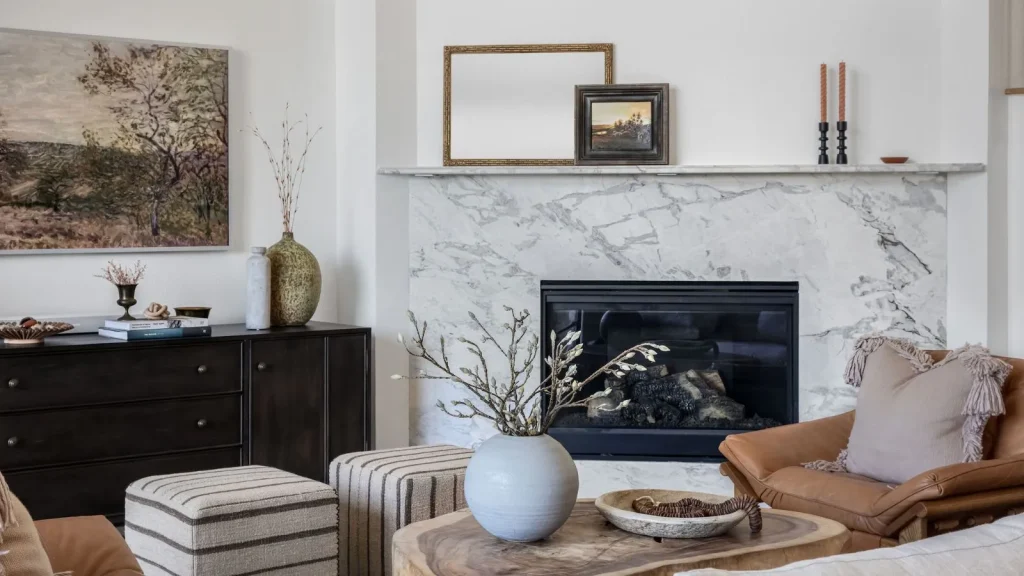
Group Similar Objects Instead of Spreading Them
Five decorative objects scattered across five surfaces create more visual interruptions than the same objects arranged as one thoughtful group. Concentration can therefore make a room feel calmer without requiring you to own less.
Books, ceramics, framed photos, and everyday items can often be gathered into defined zones. Looking at calmer interior ideas may also help when deciding which surfaces deserve decoration and which should remain mostly open.
Give Everyday Items a Landing Place
Remote controls, chargers, keys, mail, and children’s items create recurring clutter because they move constantly. Attractive boxes, baskets, drawers, and trays work best when placed near the point where those objects are actually used.
| Clutter Source | Simple Adjustment | Result |
|---|---|---|
| Small scattered decor | Create grouped displays | Fewer visual stops |
| Exposed cables | Route or contain them | Cleaner edges |
| Too many patterns | Repeat fewer motifs | Stronger continuity |
| Crowded tables | Clear working space | More breathing room |
Simplify the Furniture Boundaries
Rooms feel busier when furniture creates too many separate islands. A chair floating far from the sofa, a small table between unrelated pieces, or several tiny storage units can break the room into fragments.
Pull related pieces into clearer conversation zones. Studying uncluttered outdoor layouts can reinforce the same spatial principle: defined activity areas generally feel easier to understand when circulation remains open around them.
Avoid pushing everything against the walls automatically. Sometimes tighter furniture grouping actually creates more visible open floor.
What Decluttering Advice Often Misses
Removing objects won’t solve visual clutter if the remaining furniture still competes in scale, color, and style. A sparse room can feel chaotic when every major piece demands attention.
Another overlooked problem is storage that creates more display space. Adding open shelves to organize clutter may simply move the clutter vertically.
Closed storage works better for visually inconsistent necessities. Save open surfaces for objects you intentionally want to see.
Frequently Asked Questions
Why does my living room look cluttered even after cleaning?
Visual clutter can come from competing patterns, furniture placement, open storage, visible cables, and too many small decorative elements. Cleaning removes mess, but simplifying visual relationships may be necessary before the room feels calmer.
Should I remove all decorations from a busy room?
No. Keep items that provide meaning or support the room’s design. Grouping several objects together and leaving other surfaces open usually creates more order than removing every personal detail.
Does matching furniture reduce visual clutter?
Some repetition can help, but everything doesn’t need to match. Repeating a few colors, materials, shapes, or finishes creates continuity while still allowing individual pieces to have character.
Reduce Competition, Not Character
Look for the places where too many objects demand attention at once. Group smaller belongings, hide visually messy necessities, simplify furniture zones, and leave several surfaces intentionally quiet. The room doesn’t need to become minimal. It needs a clearer hierarchy so the things worth noticing aren’t competing with everything around them.